
Cedrus libani: Difference between revisions
No edit summary |
m 1 revision imported |
(No difference)
| |
Latest revision as of 16:00, 11 June 2026
| {{#switch:Plantae | Animalia=style="background-color:pink" | Plantae=style="background-color:palegreen" | Fungi=style="background-color:navajowhite" | {{#switch:Vulnerable|Extinct=†|}}Cedrus libani A. Rich. | ||||||
 © Wikimedia Commons | ||||||||||
| {{#switch:Plantae | Animalia=style="background-color:pink" | Plantae=style="background-color:palegreen" | Fungi=style="background-color:navajowhite" | Taxonomic classification | ||||||
| ||||||||||
| {{#switch:Plantae | Animalia=style="background-color:pink" | Plantae=style="background-color:palegreen" | Fungi=style="background-color:navajowhite" | Conservation status | ||||||
|
{{#switch:Vulnerable |
Not Evaluated=Category:Not Evaluated | Least Concern=
|
Near Threatened=
|
Vulnerable=
|
Endangered=File:Status iucn3.1 EN.svg
|
Critically Endangered=File:Status iucn3.1 CR.svg
|
Extinct in the Wild=File:Status iucn3.1 EW.svg
|
Extinct=File:Status iucn3.1 EX.svg | ||
| {{#switch:Plantae | Animalia=style="background-color:pink" | Plantae=style="background-color:palegreen" | Fungi=style="background-color:navajowhite" | Endemism | ||||||
| {{#switch:Plantae | Animalia=style="background-color:pink" | Plantae=style="background-color:palegreen" | Fungi=style="background-color:navajowhite" | Common names | ||||||
|
| {{#switch:Plantae | Animalia=style="background-color:pink" | Plantae=style="background-color:palegreen" | Fungi=style="background-color:navajowhite" | {{#switch:Vulnerable|Extinct=†|}}Cedrus libani A. Rich. | ||||||
| Error creating thumbnail: © Wikimedia Commons | ||||||||||
| {{#switch:Plantae | Animalia=style="background-color:pink" | Plantae=style="background-color:palegreen" | Fungi=style="background-color:navajowhite" | Taxonomic classification | ||||||
| ||||||||||
| {{#switch:Plantae | Animalia=style="background-color:pink" | Plantae=style="background-color:palegreen" | Fungi=style="background-color:navajowhite" | Conservation status | ||||||
|
{{#switch:Vulnerable |
Not Evaluated=Category:Not Evaluated | Least Concern=Error creating thumbnail:
|
Near Threatened=Error creating thumbnail:
|
Vulnerable=Error creating thumbnail:
|
Endangered=File:Status iucn3.1 EN.svg
|
Critically Endangered=File:Status iucn3.1 CR.svg
|
Extinct in the Wild=File:Status iucn3.1 EW.svg
|
Extinct=File:Status iucn3.1 EX.svg | ||
| {{#switch:Plantae | Animalia=style="background-color:pink" | Plantae=style="background-color:palegreen" | Fungi=style="background-color:navajowhite" | Endemism | ||||||
| {{#switch:Plantae | Animalia=style="background-color:pink" | Plantae=style="background-color:palegreen" | Fungi=style="background-color:navajowhite" | Common names | ||||||
|
Cedrus libani is an evergreen conifer growing on calcareous, well-drained soils on high mountains, at altitudes of 1200-1900m above sea level. It is adapted to cold winters, snow, frost, as well as drought.
This tree can reach a height of 40m. It has dark gray to blackish brown scaly bark that features horizontal fissures. Leaves are quadrangular and needle-like (15-35mm x 1mm), arranged in spirals on long shoots, and in rosettes on short shoots. Younger trees tend to have a greenish color and a pyramid-shaped canopy, while old trees are grayish and form a broad canopy with distinct horizontal branches.
Male cones are erect catkins, 4-5cm, pale green to orange-brown. Female cones are barrel-shaped, 7-10cm x 4-7cm, sessile, resinous, pale green to purplish-gray, which turn brown at full maturity. Both male and female cones grow on the same tree (monoecious plant), on the terminal end of short shoots. The seeds are ovoid, thin and winged.
Synonyms
{{#switch:Yes
|Yes=This species may also be referred to as:
|No=There are currently no known synonyms for this species.
}}
Abies cedrus, Cedrus brevifolia, Pinus cedrus
Possible confusion
{{#switch:Yes
|Yes=This species might be confused with the following similar-looking species:
|No=There are currently no known species resembling this one closely enough to cause any confusion.
}}
Abies cilicica
Uses & Toxicity
| The information provided on this website is for educational and informational purposes only. Please consult an expert before touching or consuming any part of a plant or mushroom. |
Edible: {{#switch:No
|Yes=Yes
|No=No}}{{#if:|, }} {{#ifeq:No|Yes|}}
Medicinal: {{#switch:No
|Yes=Yes
|No=No}}{{#if:|, }} {{#ifeq:No|Yes|}}
Other uses: Ornamental, also anciently used as timber (now protected from cutting by law)
Toxicity: Non-poisonous{{#if:|, }}
Phenology
| Month | JAN | FEB | MAR | APR | MAY | JUN | JUL | AUG | SEP | OCT | NOV | DEC |
|---|---|---|---|---|---|---|---|---|---|---|---|---|
| Leaves | 1=style="background-color:;opacity:0.5"|2=style="background-color:;opacity:1"}}|{{#if:|}} | 1=style="background-color:;opacity:0.5"|2=style="background-color:;opacity:1"}}|{{#if:|}} | 1=style="background-color:;opacity:0.5"|2=style="background-color:;opacity:1"}}|{{#if:{|}} | 1=style="background-color:;opacity:0.5"|2=style="background-color:;opacity:1"}}|{{#if:|}} | 1=style="background-color:;opacity:0.5"|2=style="background-color:;opacity:1"}}|{{#if:|}} | 1=style="background-color:;opacity:0.5"|2=style="background-color:;opacity:1"}}|{{#if:|}} | 1=style="background-color:;opacity:0.5"|2=style="background-color:;opacity:1"}}|{{#if:|}} | 1=style="background-color:;opacity:0.5"|2=style="background-color:;opacity:1"}}|{{#if:|}} | 1=style="background-color:;opacity:0.5"|2=style="background-color:;opacity:1"}}|{{#if:|}} | 1=style="background-color:;opacity:0.5"|2=style="background-color:;opacity:1"}}|{{#if:|}} | 1=style="background-color:;opacity:0.5"|2=style="background-color:;opacity:1"}}|{{#if:|}} | 1=style="background-color:;opacity:0.5"|2=style="background-color:;opacity:1"}}|{{#if:|}} |
| Flowers | 1=style="background-color:;opacity:0.5"|2=style="background-color:;opacity:1"}}|{{#if:|}} | 1=style="background-color:;opacity:0.5"|2=style="background-color:;opacity:1"}}|{{#if:|}} | 1=style="background-color:;opacity:0.5"|2=style="background-color:;opacity:1"}}|{{#if:|}} | 1=style="background-color:;opacity:0.5"|2=style="background-color:;opacity:1"}}|{{#if:|}} | 1=style="background-color:;opacity:0.5"|2=style="background-color:;opacity:1"}}|{{#if:|}} | 1=style="background-color:;opacity:0.5"|2=style="background-color:;opacity:1"}}|{{#if:|}} | 1=style="background-color:;opacity:0.5"|2=style="background-color:;opacity:1"}}|{{#if:|}} | 1=style="background-color:;opacity:0.5"|2=style="background-color:;opacity:1"}}|{{#if:|}} | 1=style="background-color:;opacity:0.5"|2=style="background-color:;opacity:1"}}|{{#if:|}} | 1=style="background-color:;opacity:0.5"|2=style="background-color:;opacity:1"}}|{{#if:|}} | 1=style="background-color:;opacity:0.5"|2=style="background-color:;opacity:1"}}|{{#if:|}} | 1=style="background-color:;opacity:0.5"|2=style="background-color:;opacity:1"}}|{{#if:|}} |
| Fruits | 1=style="background-color:;opacity:0.5"|2=style="background-color:;opacity:1"}}|{{#if:|}} | 1=style="background-color:;opacity:0.5"|2=style="background-color:;opacity:1"}}|{{#if:|}} | 1=style="background-color:;opacity:0.5"|2=style="background-color:;opacity:1"}}|{{#if:|}} | 1=style="background-color:;opacity:0.5"|2=style="background-color:;opacity:1"}}|{{#if:|}} | 1=style="background-color:;opacity:0.5"|2=style="background-color:;opacity:1"}}|{{#if:|}} | 1=style="background-color:;opacity:0.5"|2=style="background-color:;opacity:1"}}|{{#if:|}} | 1=style="background-color:;opacity:0.5"|2=style="background-color:;opacity:1"}}|{{#if:|}} | 1=style="background-color:;opacity:0.5"|2=style="background-color:;opacity:1"}}|{{#if:|}} | 1=style="background-color:;opacity:0.5"|2=style="background-color:;opacity:1"}}|{{#if:|}} | 1=style="background-color:;opacity:0.5"|2=style="background-color:;opacity:1"}}|{{#if:|}} | 1=style="background-color:;opacity:0.5"|2=style="background-color:;opacity:1"}}|{{#if:|}} | 1=style="background-color:;opacity:0.5"|2=style="background-color:;opacity:1"}}|{{#if:|}} |
Gallery
-
 Cones (© Wikimedia Commons)
 -
 Leaves (© Wikimedia Commons)
 -
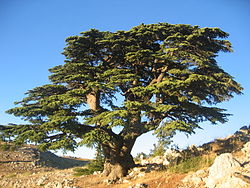 Old tree (© Wikimedia Commons)
 -
 Cedar of God forest (© Wikimedia Commons)
 -
 Cedar of God forest (© Wikimedia Commons)


,_Lebanon.jpg)
,_Lebanon.jpg)


References
- ↑ Gardner, M. 2013. Cedrus libani. The IUCN Red List of Threatened Species 2013: e.T46191675A46192926. https://dx.doi.org/10.2305/IUCN.UK.2013-1.RLTS.T46191675A46192926.en
- Pinaceae
- Not Evaluated
- Least Concern
- Near Threatened
- Vulnerable
- Pages with broken file links
- Endangered
- Critically Endangered
- Extinct in the Wild
- Extinct
- High mountains
- Edible
- Medicinal
- Ornamental
- Timber
- Non-poisonous
- Leaves in January
- Leaves in February
- Leaves in March
- Leaves in April
- Leaves in May
- Leaves in June
- Leaves in July
- Leaves in August
- Leaves in September
- Leaves in October
- Leaves in November
- Leaves in December
- Flowers in January
- Flowers in February
- Flowers in March
- Flowers in April
- Flowers in May
- Flowers in June
- Flowers in July
- Flowers in August
- Flowers in September
- Flowers in October
- Flowers in November
- Flowers in December
- Fruits in January
- Fruits in February
- Fruits in March
- Fruits in April
- Fruits in May
- Fruits in June
- Fruits in July
- Fruits in August
- Fruits in September
- Fruits in October
- Fruits in November
- Fruits in December